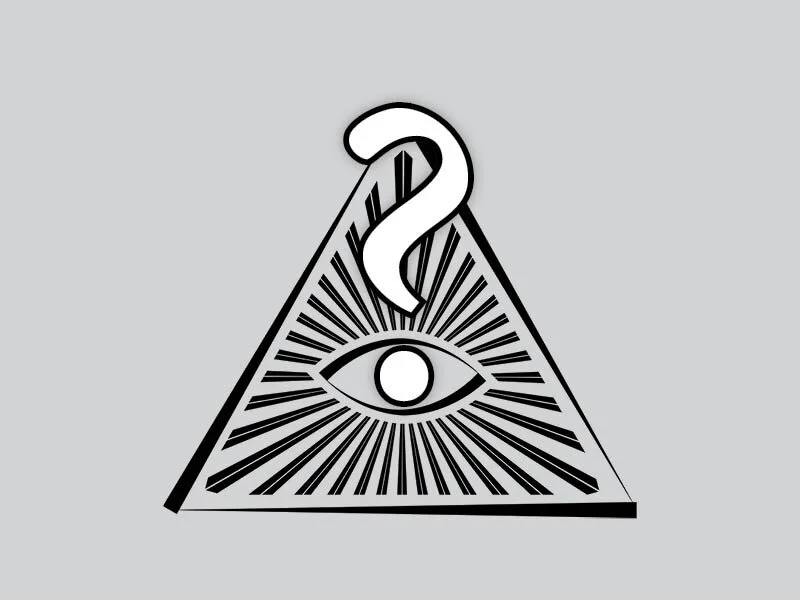
Are You There, Q? It’s Me, America.
Our Beloved Cults
An interesting thing happened as Joe Biden was sworn into office. It happened mostly in the darker corners of the internet, where echo chambers and magical thinking give life to phenomena like QAnon. As Air Force One left ground to the final bars of Sinatra’s vapid My Way, many QAnon believers were left to suck the exhaust fumes and figure out what went wrong.
Had they been duped? Was Biden now working with Q? Was the “The Plan” that so many so deeply trusted actually an elaborate psyop?
As the day wore on, some retained some hope that The Storm would indeed come. It didn’t. In this little corner of the American Northeast, there was a picturesque snow flurry, the kind Ridley Scott is so fond of in his films. Not what they had in mind.
Across America, the true believers of republican democracy breathed a sigh of relief. It was over. The orange boogeyman was gone (for now). His devotees were (temporarily) left rudderless.
Maybe. Or maybe us true believers of democracy are on psychological ground only slightly sturdier than the Q Believers.
If I could sum up my hope for the most salient lesson here in the aftermath of the Trump era, it would be this: disillusionment. Disillusionment has some negative connotations. Per Merriam Webster: “having lost faith or trust in something formerly regarded as good or valuable.” But on a more fundamental level, disillusionment is a death of illusion. It’s an awakening.
The extreme elements of the right have (possibly) awakened to the fact that with Donald Trump and QAnon, there simply was no there, there. It was all bullshit: some of it self-generated, some of it foisted on them. QAnon was and is a cult, it seems. Moreover, it’s an American cult among many others.
American Occultic
The word cult has been weaponized. Labeling an ideology a cult or a theory a conspiracy theory essentially ends the discussion, even though there may be much more to discuss. The political left, media left, and centrist media have been quick to label QAnon a cult, and the specter of the QAnon Shaman seems to confirm precisely that. The term seems accurate. There are undeniable religious overtones here.
The scholar Erik Davis summed it up best:
“But if you are still managing to cling to the idea that the contemporary world is comprehensible, and that historical events remain distinguishable from bizarre and fabulous imaginings, you now have to face the spectacle of the Q Shaman howling to his heathen transdimensional gods in the Senate chambers of our benighted republic."
History informs us that ideological movements are cults until they are not -- until they hit a tipping point and become mainstream or until they die or are eradicated. Take Christianity, for example, which was considered a cult by the Roman Empire and driven literally underground. National socialism was a cult until we fought a war to eliminate it. The same goes for Soviet communism.
Whether we choose to see it, we all belong to cults, some of which are our own creation. And, to complicate matters, we excel at bullshitting ourselves to the contrary. Among us, there are members of the Cult of the Deal and the Cult of Getting who look for material goods or money saved to make them whole. Venture into the minefield of social media and you will see devotees to the Cult of the Flesh -- those who have otherized their own bodies so that they might idolize and iconize them. Then there are the more profane cults: The Cult of the Gun, The Cult of the Like, The Cult of the iPhone.
Real pain
There’s a sense of longing underpinning all of these cults. As a member of the Cult of Getting, I feel this longing every time I look at a well-made vehicle and slip into a highly irrational mind state of seeming gnosis, thinking, yes, I will feel better when I’m sitting behind the wheel of that. This feeling coexists with the rational knowledge that I might feel different or better for a little while, and then certainly, I won’t. This is a scientifically validated phenomenon.
I suspect the rise of QAnon is similar to the rise of the more socially acceptable cults we’ve joined. Consciously or unconsciously, we’re all longing for something and historically, that longing--that feeling of truly knowing--might have been addressed by spiritual practice.
Nietzsche was wrong. God's not dead. Here in America, we chase her illusion and wind up QAnon believers, Costco members, smartphone addicts, and seekers not of wisdom, but of the best deals. We’re looking for God in the back of the wholesale club warehouse, where they stack the toilet paper like a profane Tower of Babel.
This is what keeps some of us (though there are fewer each decade) in organized religion. God's not dead, but organized religion is certainly dying. Those old enlightenment values (sometimes a religion unto themselves) are doing the killing. The problem is that in jettisoning religion, we’re throwing out the baby (spirituality) with the bathwater (religion). QAnon, and other aforementioned cults, are all a byproduct. We wander the earth as soulless, hungry ghosts looking for something that makes sense, something that feels good, something to fill the void. And we end up worshipping at the altars of any or many of these cults, or worse, the Cult of Narcissism.
Embracing disillusionment
The good news is that we can choose to wake up. We can choose to commit ourselves to lives of disillusionment. It starts with choosing to stop bullshitting ourselves. We can take things seriously, while holding them lightly. We can question deeply while remaining open to the possibility that ultimately, we do not know.
Unfortunately, I’d be bullshitting myself and you if I told you that I know how to do that. There is no script for disillusionment. If there was, it would eliminate the need for Zen koans, bible verses, talmudic scholarship, and other forms of weird or conventional DIY seekership. But I do believe that there’s something to be said for doing something that works for you, and doing it consistently.
Generally speaking, I think becoming a sponge for wisdom, having a physical practice, and having a spiritual practice constitute a crude map of the territory. For example, these days I make it a point to take in the thinking from people on all sides of the political and ideological divide. I study philosophy. I train Jiu Jitsu and lift. And I meditate and journal. Perhaps some of that works for you, perhaps none of it does. You need to come up with your own combination.
I have no idea where these practices are taking me. But I do know this: The older I get and the more deeply invested I am in these practices, the more connected I feel. Hopefully that means I’m bullshitting myself a little less. Hopefully that means the illusions are dying. Hopefully that means I can identify the cults I’ve selected and created.
Then again, I could be bullshitting myself. I strive to take things seriously, while holding them lightly.